What is Databricks AI Index?
The Databricks AI Index is a public resource combining anonymized enterprise AI usage and spending data with weekly coding-agent benchmarks. Learn what it publishes and how to read it.
Updated ·
Databricks AI Index: Enterprise AI Adoption, Spending and Coding-Agent Benchmarks
Announcement date:
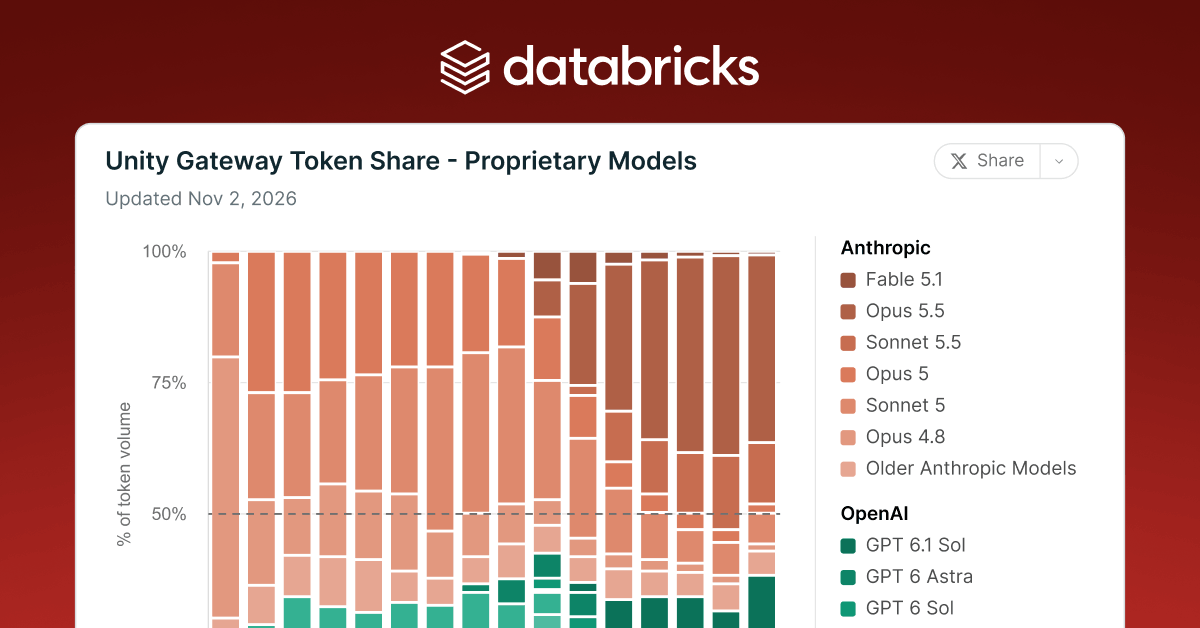
The Databricks AI Index is a public resource from Databricks that combines aggregated, anonymized enterprise AI usage and spending data with a permanently public coding-agent evaluation suite. It is designed to show how companies actually consume models — how many providers they use, how much open-weight traffic they carry, and which model-harness combinations deliver the best trade-off between task success and cost. The current dataset covers September 21 through November 7, 2026, and the benchmark side is updated weekly as new proprietary and open-weight models are released.
What the Databricks AI Index is
Databricks launched the Databricks AI Index as a public resource that brings enterprise AI usage and spending insights together with coding-agent evaluations in one place. Rather than a single report, it is an ongoing index: usage data is refreshed as the underlying traffic changes, and the evaluation suite is published permanently with weekly updates as new proprietary and open-weight models are evaluated.
The usage side is built on aggregated, anonymized data from more than 10,000 companies using Unity Gateway, spanning digital natives, Fortune 500 and Global 2000 enterprises. Because Unity Gateway also routes traffic to external providers such as Anthropic and OpenAI, the Index can reflect multi-provider behavior rather than only Databricks-hosted models.
- A public resource combining enterprise AI usage and spending data with coding-agent evaluations
- Includes a permanently public internal evaluation suite updated weekly
- Usage data comes from 10,000+ companies on Unity Gateway, including traffic to external providers
What data the Index publishes
The Index publishes two broad categories of information. The first is enterprise adoption and spending: which model providers organizations use, how concentrated or diversified that usage is, and how token traffic splits between proprietary and open-weight models. Model spending is estimated using publicly listed provider prices rather than negotiated contract terms.
The second category is coding-agent performance. Benchmarks compare model-harness combinations on task success rate and cost per completed task, so readers can see not just which model is most capable but which combinations sit on the cost-quality frontier. Databricks notes that results reflect the workloads and models evaluated and may vary across organizations.
- Adoption metrics: number of model providers per enterprise and provider mix
- Token traffic share for open-weight versus proprietary models
- Estimated model spending based on publicly listed provider prices
- Coding-agent task success rates and cost per completed task
Update cadence and dataset coverage
The current dataset covers September 21 through November 7, 2026. The evaluation suite is updated weekly as new proprietary and open-weight model releases are evaluated, which makes the Index a moving snapshot rather than a fixed annual study.
Because the window is short, the Index is best read as a directional signal about fast-moving enterprise behavior. Comparisons across releases are useful for spotting shifts in provider diversification and open-weight adoption, but the underlying workloads and model lineup change over time.
- Current dataset window: September 21 to November 7, 2026
- Benchmark evaluations refresh weekly with new model releases
- Spending figures are estimates from public list prices, not billed amounts
How coding-agent performance and cost are measured
The coding-agent evaluations are built from real coding-agent workflows used by Databricks engineers and captured through Unity Gateway. These workflows span creating and reviewing pull requests, investigating issues, and tackling complex development tasks, so the benchmark reflects production-style work rather than isolated puzzle problems.
To reduce benchmark contamination risk, tasks come from Databricks' private codebase and withheld tests. Results are evaluated against hidden tests rather than an LLM judge, and models are compared as model-harness combinations — for example using Claude Code and Codex — on task success rate and cost per completed task. The latest benchmark evaluates models across nine AI labs.
- Tasks drawn from real engineering workflows: PR creation and review, issue investigation, complex development
- Private codebase and withheld tests reduce contamination risk
- Scored against hidden tests, not an LLM judge
- Compared on task success rate and cost per completed task across model-harness combinations
Headline findings on multi-model and open-weight adoption
The most striking adoption signal is diversification. As recently as July, approximately 64% of enterprises using Unity Gateway relied on just one model provider. By November 2, that had fallen to 28%, as more organizations adopted models from two or more providers.
Open-weight models show a similar trajectory. Their share of enterprise token traffic grew from 7.3% in July to 30.9% in November — more than quadrupling in less than four months. On the coding quality benchmark, three open-weight models rank among the top 10, including DeepSeek V4.1 and GLM 5.3, which both rank third with a 93.1% pass rate. In the latest coding-agent benchmark, five models from four labs — OpenAI, DeepSeek, Meta and Anthropic — sit on the cost-quality frontier.
- Single-provider enterprises fell from about 64% in July to 28% by November 2
- Open-weight share of enterprise token traffic rose from 7.3% in July to 30.9% in November
- Three open-weight models rank in the coding quality top 10, with DeepSeek V4.1 and GLM 5.3 tied third at 93.1%
- Five models from four labs sit on the cost-quality frontier in the latest coding-agent benchmark
How to use the Index in practice
The Index is most useful as a reference point when you are deciding how to structure model access. If your organization still depends on a single provider, the diversification trend is a prompt to test a second model family against your own workloads rather than assuming the Index ranking transfers directly.
For coding agents, the cost-quality framing matters more than a single leaderboard position. Compare model-harness combinations on both task success and cost per completed task, and treat the published results as a starting hypothesis to validate with your own repositories and review processes. Note that spending figures are estimates from public list prices, so actual billed costs under enterprise agreements may differ.
- Use the diversification data to justify testing a second provider
- Evaluate coding agents on cost per completed task, not success rate alone
- Validate published rankings against your own codebase and review workflow
- Treat spending figures as list-price estimates, not invoices
Questions
What is the Databricks AI Index and what data does it publish?
It is a public resource from Databricks that combines enterprise AI usage and spending data with coding-agent evaluations. It publishes adoption metrics such as the number of model providers per enterprise, open-weight versus proprietary token traffic share, estimated model spending based on public list prices, and coding-agent task success rates and cost per completed task.
How often is the Databricks AI Index updated and what period does the current dataset cover?
The evaluation suite is updated weekly as new proprietary and open-weight models are released. The current dataset covers September 21 through November 7, 2026.
How does the Databricks AI Index measure coding-agent performance and cost?
It uses real coding-agent workflows from Databricks engineers captured through Unity Gateway, covering pull request creation and review, issue investigation and complex development tasks. Tasks come from a private codebase with withheld tests, results are scored against hidden tests rather than an LLM judge, and model-harness combinations are compared on task success rate and cost per completed task.
What does the Index show about multi-model adoption and open-weight usage?
The share of enterprises relying on a single model provider fell from about 64% in July to 28% by November 2. Open-weight models' share of enterprise token traffic grew from 7.3% in July to 30.9% in November, and three open-weight models rank in the coding quality top 10.
Original sources
Tool Info
Has this tool changed? Help us keep it up to date
Databricks AI Index Reviews
Loading reviews…